Saturday, 18 July 2015

Moreton Island 3 day Wintersun bikepack - day 2

You have to 'extend to experience'. It's what I reinforce to my girls - to see that sunrise, to climb that peak, to achieve that goal - you need to extend your boundaries and push yourself to experience some of the incredible things that nature and life has to offer. Rewards don't come to you unless you've earned them.
 
I felt like a dawn patrol ride up to Cape Moreton lighthouse and back before breakfast, I'm not one for sleeping in. Starting out in complete darkness, it's a delight to watch the dawn unfold and the sky warm to the sun's touch.
 

I shared the early rays with a pair of pied oyster catchers.


The solace of a sunrise; a bike and a beach with no imprint of mans hand (or foot, or tyre, but c'mon the hand is a metaphor)


On the way back, I passed a campsite, with a guy meditating on the frontal dune. He didn't respond to my wave, can only think he was wishing he had a fatbike.


Always comes back to food, as wifey often says. The pet monkey reckons it always comes back to poo, but she's 9 - kids seem fascinated with body functions.

Okay brekky is a simple affair - 2 packets of instant porridge (just add boiling water and stir) but I also like a bit of a granular/fruity feel to brekky, so in goes a fruity muesli/granola bar for texture and extra sugar, topped with a honey shot just to tip over the calorie scale. This is another simple, cheap and easily packed/stored staple meal. Summertime trips I'll pack rolled oat cereal, mixed in with full fat milk powder and sugar in a ziplock - again just add water and eat straight from the ziplock.


I don't drink coffee at all, but I can't deny the effect of a caffeine hit in the morning - best way for me is via an Espresso Chip Bonk Breaker bar - made with real espresso beans.


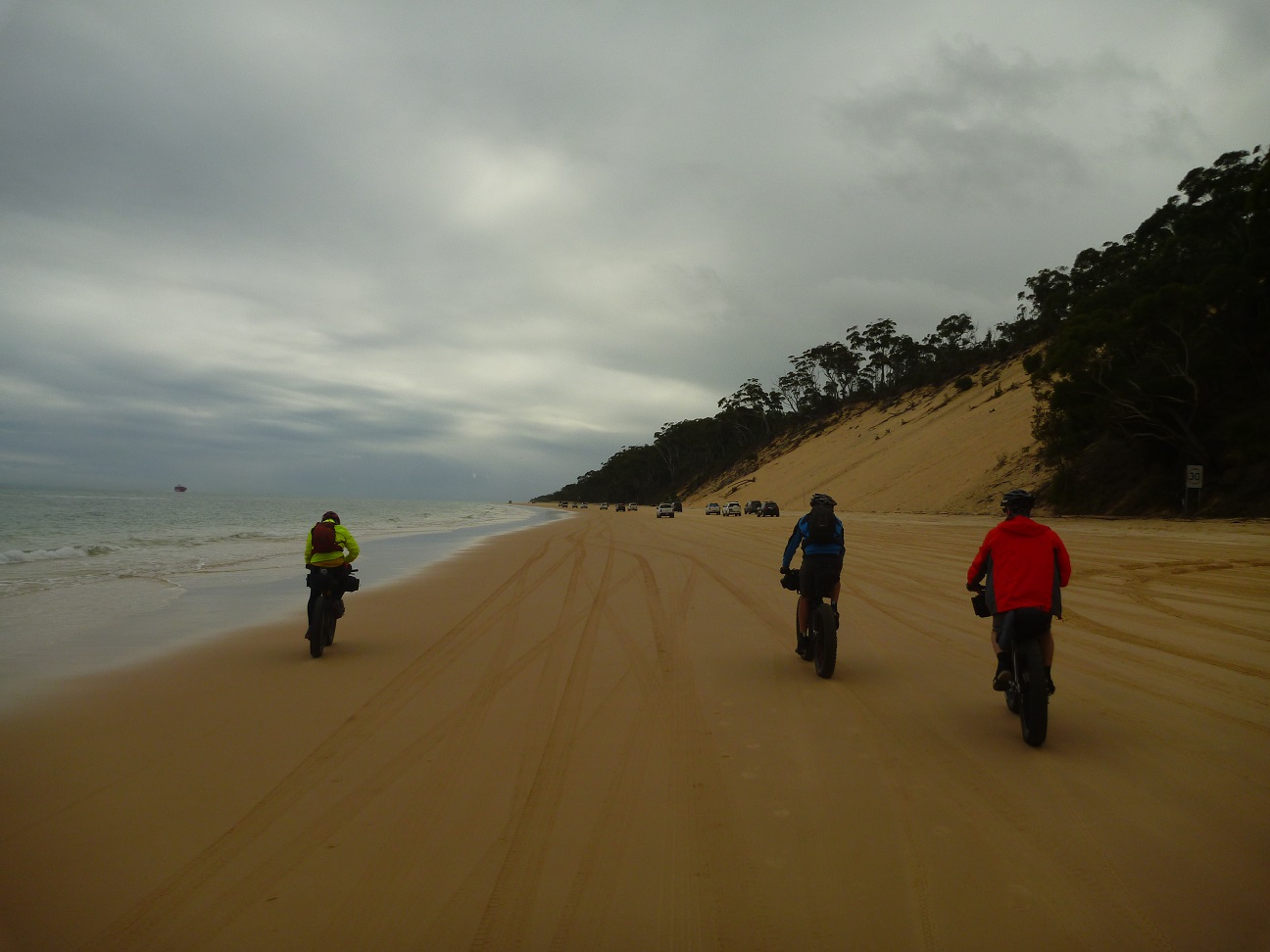
With gear packed and stowed, we rolled out to the beach to an instant spectacle of humpback whales directly offshore, just beyond the breakers.


The inland tracks were firm with high moisture content, the next stop being the rewarding walk to the summit of Mt Tempest - at 285m it is regarded as the highest coastal sand dune in the world.


 360 degree panoramas, views extending as far as Cunninghams Gap, Mt Warning, Glasshouse Mtns and Mt Coolum.

 Like any bush setting, there are always bushfires due to seasonal storms (lightning strikes) and unmanaged campfires. For many plants though, fire is essential for life, as it cracks open seed pods and assists with germination. You see many after effects of fire on the island, with charcoal scarred trunks - but it is interesting to see the adaptations to fire. The cork-like bark of this coastal Banksia protects it against the ravages of fire.


Middle Rd - often a churned up pushfest - was totally rideable and the descents put a grin on everyones' faces.


Back onto the west coast for a short cruise south to Tangalooma for a quick smoko.


Tangalooma Resort now have fatbikes for hire too. I'm not sure how far you could take them or the scope of rental, but still great to see. We topped off water bags and bottles, off to the next destination and one that was quite testing to get too. Of course there is an easier way, but 'easy' does not equal my 'type 2 fun'.
 

 Stairs. I can't read minds, but my basic intuition was telling me that I was the only one that enjoyed this segment. 'The reward is worth it you guys' and 'it makes for a better loop with no doubling back' or 'this way is the easier of the two options' was only having a marginal affect - I don't think they were buying it. I was having fun :) This is just a part of bikepacking, that nobody is shielded from.


'C'mon you guys, push! This reminds me of Iditarod!'


The familiar view of The Desert. Families were out sand toboganning and enjoying the great weather.


The loose plan was to take the left side and just ride the contours down to an area called Lightning Ridge. It's the site of many lightning strikes in the sand and has fused into glasslike clusters. Approaching The Desert from the western edge, allowed us to traverse to the 4wd track and to the Rous Battery trailhead with no doubling back.


Our target for the night was Rous Battery, an old military site with various intriguing buildings, many subterranean and some underground as well (couldn't resist the Coight gag) but first we traverse the Rous Battery track south east. This is a very pleasant track, gentle downhill grade with a surface of firm sand and leaf litter.


No, we didn't eat the mushrooms, but the speed of some of the descents made camera-ing a bit harder than normal. We wandered around the battery - some of the buildings were quite obvious - quarters, lookout post, gun emplacement and armoury.


Rous Battery campsite is a pearler - a few dunes back and enough elevation to feel like a master of the universe. Simple camping again for me, no rain but I could tell early on that the night would be buggy.


A little bit of tech on layering: my day clothes form part of the sleep system, and careful selection and refinement over the years allow me to stay fairly clean, with very minimal use of chemicals (sunscreen and bug repellent). Y'all gotta tolerate gettin' a bit icky too - all part of it.

From the top: I wore a Frillneck hat with full neck and side coverage, over this I wear a Sea-to-Summit micro bugnet as needed; a winter and a summer Buff for versatility; torso baselayer is a sleeveless open 5mm weave mesh (yeah, the kind you'd wear to a Euro rave); a long sleeve synthetic wicking shirt; a synthetic wicking short sleeve tee over the top of that (The North Face Vapourwick is a fantastic technical, multiweave fabric that outperforms many other synthetic and organic options, in my experience); Sugoi bibshorts (the shop kit) with fleece lined cycling leg warmers (I sleep in my day layers - here's a tip: I pull the bibshorts down a bit to allow air circulation around the nether regions - after hygiene routine - and roll down the silicone grippers on the leg warmers, onto themselves OFF the skin, to prevent skin irritation); polycotton socks; Lake MX100 boot with Moxie Gear ankle gaiters (these really keep a lot of sand out of the boots). My final top layers (the only extra layers I packed) were a pair of long pants - Macpac Crossterrain with long ankle zippers (for easy on/off with boots on) and ultra packable TNF Primaloft technical smock with 1/4 zip. It's a fave of mine, it has no hand pockets (extra unnecessary material and zips) and breathable panels in key perspiration zones. Good design and quality materials are the keys to functional layers.

Some of the above may sound disgusting, but it can be impractical to carry a gear change for nights and a time vampire during multi-week races if you're doing multiple changes each day. I follow a hygiene routine with baby wipes followed with talc on the nether regions. YMMV in these instances, but you've gotta practice it to find what works and you have to train your body and mind to adapt to suit. You can travel lighter, faster and enjoy more of the trip without being tied down to a more civilised regimen.

Ultimately, each of us have to devise our own systems that work for us. The only way to do that is to get out there and gain that experience in a variety of conditions - 'indoor' product testing will only prep you so far...

When I need to interact with non-bikepacking civilians, I splash on a bit of product so I don't offend. Ride Mechanic and I worked on a 'scent project' for Iditarod - and came up with a multi-function fluid that has many, many uses - I had several criteria I wanted it to cover:
  • Smell nice (without masking your pheromones to the chicks)
  • Antibacterial properties (wound treatment OWWWWEEE)
  • Degrease a dirty chain (this is so fun to do in the field) 
  • Burns in a fuel stove (pop can stove lightness)
  • De-waters skin without stripping fatty oils (drying out wet skin)
  • Firestarter (when all your kindling is a touch wet)
I decant this into a small eyedropper bottle for ease of use and of course, miniaturisation.


On that note, let's talk food :) Dinner was the same as last night. Meh, food is fuel - it doesn't need to be gourmet, just has to satisfy clean burning calorie needs with moderate nutrition (can always add a multivitamin supplement - your healthy food pyramid will be waiting for you when you get home) We had a decent campfire that night too, but an early one for me! That night I watched the half moon rise from my bed, along with the lightning show in cumulonimbus clouds far out to sea.
 
This is the thing I fully enjoy the most about open sky camping - the stars, the night silhouettes, the  elemental exposure. Don't get me wrong, I have plenty of tent options and use them as required, but when it's stable weather out, I like to indulge in simple setups. Quicker, lighter and less stuff to fuss over - a nice escape from modern life and I feel you absorb the overall experience deeper too.

Wednesday, 15 July 2015

Moreton Island 3 day Wintersun bikepack - day 1


I've said it before, Moreton Island is truly the jewel in the crown for Brisbane fatbike adventurers.

When a good mate Neil mentioned he was heading over to Moreton for a beach bikepacking trip  (bikepacking is where you load up your bike with the bare minimum of gear, instead of loading up the 4wd with nearly the entire BCF catalogue) I volunteered as tour guide to share a favourite route of mine. It had the lot. Beautiful beaches, inland tracks, fresh water lagoons and streams, rideable sand blows and plenty of 'type 2 fun' physical challenges.

Neil has a great blog, he writes about a diverse range of topics and will have his story up of this weekend any day now. It is also a treasure trove of trail information on SEQ tracks - highly recommended read!

My day started early, with a ride from home out to the Micat ferry terminal, from which it's a pleasant 70 minute trip over to the island.


There are plenty of places to stuff a fatbike on the Micat.


The beach was firm right up to the high tide mark, with a bit of rain about.


The Alpha lineup, my compadres on this trip were Tony, Paul and Neil. I hoped they were ready for some of my type 2 fun. I was on my Rohloffed Moonlander, Tony was on his titanium Muru Witjira, Paul on the Specialised Fatboy, and Neil on arguably the second most capable bike in the world - the loaner! (second only to the rental) Wayne (another fatbiking mate), the owner of the loaner, was off on a bikepacking trip in Korea, so what happened to the loaner on the trip...stays on the trip ;)


We all kinda got lost in our thoughts, just turning the legs over as the km passed by. Light sprinkles of rain came and went, as we traversed bay after bay, until the final turn around Comboyuro Point. We were often under the watchful eyes of sea eagles, whistling kites, pelicans and pied oyster catchers.


Heath Island is a dynamic region on the North-West of the island - with a lagoon/billabong at the base of Yellow Patch - a giant sand blow. The tidal outflow constantly shapes the beachfront, as a consequence our path meandered randomly according to firm sand and open gaps between tree deadfall.


We rounded North point to overlook Honeymoon Bay and a quick stop for lunch. The rain was slowly setting in - a nice hot cuppa-soup and a Nutella English fruit muffin filled the void and warmed the belly.


A quick push around the point, purely for the drill and a prelude for the trails I had in mind over the next few days.


The views from Cape Moreton are fantastic - off in the distance we spied whales breaching.

...and we thought we had issues with the wind...


...but little did he know he was being pursued by a mother Humpback and her calf!


Our journey took us along the East beach, through 6 or 7 fresh water lagoon outlets, stopping off at Blue Lagoon to top off the water bags, take in the view, enjoy the significant birdlife and ponder the lives of all who have called this region home over the years.


We chose a campsite not far south of Middle Rd, on the East beach. Plenty of room for all - even the snorers :)


Simplicity for me, the tarp for the errant shower and bug net there just in case. For the tech curious: I'm using a Gram Counter silnylon footprint; Klymit X-frame inflatable pad; Mountain Hardwear Ultralamina 32 synthetic bag; Sea-to-Summit 1p bugnet; Integral Designs 2p silnylon tarp. Contrast to all that - the pillow is 2 microfiber towels stitched together to form a drawstring pocket, filled with the sleeping bag drybag, gloves, neck gaiter, hat and Arcteryx synthetic insulated vest.


We cooked dinner, engaged in conversation, some had wine and cheese and we all enjoyed the final light of day fade.


...some did it with more style than others. Paul just needed a matching tweed dinner jacket and pipe - those slippers were a classic!


Speaking of food - a bit more tech: dinner was a cheap, reliable staple of mine - Couscous and foil tuna. Only need a small amount of water to re-hydrate and requires no fussing - so you've got hands free to do other things. My trick is to use unflavoured couscous, then flavour it with a noodle cuppa soup like Italian Minestrone - adds a bit of colour, flavour and floaties that resemble hydrated vegetables. Couscous packs a punch calorie wise too, easy to store, great shelf life. Mix the tuna in whenever you like. I prefer tuna in oil varieties, it lubricates the couscous, adds a few more calories and increases satiety. I used Salmon in foil packs on the Iditarod, less chance of the flesh freezing with a higher oil content. Takes about 250ml of water to hydrate the 1/2 cup dry couscous and soup mixture, and wash up the kit (which is just swish some water around the cup and consume).


I'm using a Kovea ti stove, 600mL alloy pot (canister and stove nest into pot) Sea-to-Summit collapsible cup, MSR folding spoon, 500mL bottle with Hydroflask flip cap.


...and of course dessert. Never go to bed depleted!


Wednesday, 6 May 2015

Iditarod Trail Invitational 2015 - Prologue


There isn't a day that goes by, I don't think about the Iditarod trail.

It will never leave me.

Other people who've spent time on the trail know this feeling.

So I sit here in my kitchen eating instant noodles in a foam cup, not wanting to unpack my bike, as if to preserve that precious feeling of pre-departure - it becomes this speed bump of memories in my gear room, where I'm forced to slow down, forget what I went in there for and slump in the futon, to dream of the trail.


Dream with me for a moment.

It's quiet - no, it's absolutely silent. The air is cold, fresh and utterly pure. You are warm and dry. Surrounded by snow laden spruce and a pillowed carpet of the whitest and deepest marshmallow snow. The tall, white capped mountains have been at your side for many hours, you're aware of a path you've been following but the importance of exactly where you are on it has faded. Not lost, just lost in the moment and savouring the vista, wishing time would paradoxically slow, in contrast to speed.


Or, it's the deepest of dark nights. Light whisperings of the aurora borealis shimmer overhead, as you roll over a polished surface of onyx, with barely a mark to guide your wandering mind. Your motion is fluid, moves are calculated and precisely controlled, yet adrenaline is battling logic to drive you forward. You can hear the dark, yawning presence of open water to your right, the depth and speed of which seems to swallow the very light you shine towards it. The onyx beneath your tyre cracks, yet does not yield a chasm to engulf you, whilst your adrenal glands fire another round to pummel your stress ridden body.


Alaska is a rich depository of these beautiful and deadly contrasts, I am eager to return.

It has a profound effect on you, in many ways. A deeper understanding and respect for wild places; how complicated modern living can be; and forging lifelong friendships through shared hardship.


I covered a lot about my plans for the race in this article: Me, myself and Iditarod, so no need to rehash here. In short I went into the race with a primary focus to complete, to race solo and bivvy each night with no support, in any weather condition. What I discovered - in vivid contrast to my plan, was a camaraderie on the trail - an ITI family - and a constantly evolving path that forces you to adapt and remain flexible in your strategy to achieve your goal.


When I crossed that finish line in McGrath, I had achieved something not just for myself - it was also an inspirational and vicarious achievement for family and friends back home who supported me. I thought of my mate Russell Worthington, whose attempt to be the first Aussie finisher in this great race, was thwarted by severe weather and hub mechanicals in 2012, a heavy weather year where over half of the race field scratched. I deem Russell a far tougher and experienced adventurer than I.  Respect.


I also received support from companies in the form of product to use on the trail. I chose these products long before sponsorship was offered - these products were chosen due to their high quality and suitability for this event. Those that know me, will know my pragmatic approach to gear and know that my approval has to be earned and not given lightly.


I hope you enjoy the race report and trail stories, the photos and the tech articles. The humour - oh the humour - things that only an ITI racer will understand. Things like 'Merchant Miles', going 'Full Throttle' at Rohn and how I'll never look at a plate of mashed potato and broccoli the same way again.


I also hope the tech articles will assist ITI rookies or anyone who may be planning a trip of their own - there is something there to inspire, educate and engage. I can't give you all the secrets - many of those you'll have to work out for yourself - that's where your adventure begins...


Monday, 1 December 2014

Me, myself and Iditarod...

I'm that red blinky light you saw riding at 4am, squeezing in a 100km before my day job; I'm that neighbour you hear lifting weights in his garage when you put the bins out; I'm that mate who never drinks or stays late at functions, choosing to get to bed early for training discipline; I'm a dedicated athlete; I'm also the everyman.

 
It may sound like I'm paraphrasing Fight Club, but the similarities of Jack and Tyler to an athletes' lifestyle are striking. As amateur athletes, we manage our double life as an athlete (training, racing, recovering) and as Joe Average (father, employee, husband, lawn mowing guy). In our mind we see the potential of our body and how we can shape it, to create our version of an Ubermensch, to achieve our goals and do something extraordinary. I'm an ordinary guy, that chooses to do extraordinary things.
I'm asked many questions when the subject of 'Iditarod' is brought up in conversation, it's hard to convey the full weight of it in a few minutes. I understand how many immediately think of the famous dogsled race in Alaska, but no, I'm not doing the dogsled race. This is an endeavour that is entirely human powered, traversing the frozen tundra and mountain passes, in the depths of an Alaskan winter on a bicycle. This article will detail what the event is, what my key motivators are and how I plan to achieve my objectives.


The event.

The Iditarod Trail Invitational (ITI) has been listed for many years, as one of the top ten human powered, ultra-endurance races in an extreme environment. Alaska in the middle of winter can serve weather extremes from 20 deg C, to -60 deg C, rain, sleet, snow, ice, high wind, avalanches. There are no roads, just snowmachine trails over frozen lakes, along rivers through wild backcountry and over high mountain passes. Very few towns exist along the route and may only comprise of a lodge or a few houses. The landscape is remote and beautiful, but deadly. The start date for the 2015 ITI is 1st March, 2:00pm at Knik Lake, Alaska. The time cutoff for the 350 mile race is 10 days, 23 hours, 59 minutes and 59 seconds.

To qualify and receive your invitation to enter, you must submit a resume of your experience in a sub-arctic environment, or successfully complete one of the organised ITI training camps, or qualify through completion of a few selected long distance winter races. The training camps are a way for race organisers to asses your skill, knowledge, competency and mental capacity for the race. Only 50 racers are selected to enter. Suffice to say, line entries are not possible. There is no prize money, completing the event is the achievement - more people have climbed Everest than completed the ITI.

To quote race organiser, Bill Merchant:

"...with the input of several veteran racers we all agreed support should be kept to a minimum. Winning or even finishing in the extremes of Alaskan winter weather depends on how comfortable the racers are with their abilities, level of experience and amount of risk they are willing to take... we allow racers to make these decisions for themselves about what to carry, when to rest and when it is safe to travel. There is no designated or marked route only mandatory checkpoints racers must pass through. We try to limit the amount of support to just what is necessary. Words from a story told by Joe May say it best and I am paraphrasing, "Some times when you offer too much support you cheat the true adventurer out of a big part of why they are on the trail. They come to race, to confront and hopefully overcome what ever is thrown their way. To solve problems for them diminishes the experience."

Full information on the event can be found on the website:

http://iditarodtrailinvitational.com/index.php


Everything you need for survival is carried on your bike. There is no support or sweep vehicle. Food, shelter, food prep kit, clothing, bike and gear spares - you carry it all in purpose made bags on the bike. These bags are designed to efficiently carry your gear, reduce overall weight and improve performance. You bivvy out under the stars, directly on the snow, with a thin foam mat to insulate your body and sleeping bag from the snow. For water you melt snow, store it in insulated bottles and (hopefully) consume it before it freezes. Calories must be consumed in the thousands, to keep up with metabolic demands of exercise, thermal and basal requirements. You must vent your clothing layers to keep perspiration minimised - wet clothes transfer more heat to the surrounding air - so you remain slightly cold to keep your layers dry.


Key motivators.

First up: a little history without being too introspective. I've always loved riding bikes. I've always loved camping. I've always loved mysterious and challenging weather, chosen solo ventures instead of team sports, strived to do things efficiently. I'm always searching for opportunities that allow me to combine these passions.

The ITI just clicks with me. It encompasses my passions and drills down to my core beliefs of self reliance, competency and draws upon my skills learnt and honed over decades of adventuring. Humans need to be challenged - our modern lives have made us forget about challenging ourselves, stepping outside of our comfort zone - our bodies and minds need stress to maintain an equilibrium, a balanced perspective. Also I'm about motivating others - I do this because I can and I'm able bodied. Too many people wait until a critical, life changing event wakes them up, shakes them by the shoulders and screams at them to do something with their physical and mental abilities as a human - but sometimes it's too late and their ship full of physical capacity has sailed a long time ago. I've not had a life changing event, I just want to maximise my potential and achieve as much as possible while I'm able bodied. I hope that those who watch me from the sidelines may be tempted to step into a game of their own and achieve their full potential too.

I'm no adrenaline junkie. This race will however force me to take calculated risks under very adverse conditions, in a cold, hungry, solo and sleep deprived state... and I will love every single second of it. This will be another level of challenge, exceeding the summits of days past - ultra-racing in New Zealand, solo bikepacking trips in foreign countries and parenting. Well, not quite parenting, but if you're a parent yourself you'll appreciate the pre-requisites of endurance, pain tolerance, patience, decision making and goal oriented focus. Our daughter is only 8, I hope she will aspire to dream big and achieve big in her life, find inspiration from my adventures, be a star pupil at my school of experience and grow confident in her abilities. My wife has been a constant sponsor in the background, even though she hasn't emerged from the same adventurous mould as myself, she has never questioned my motivations or equipment purchases. Sanity, yes, but never equipment purchases. These two chicks keep me going.
Tramping on a family trip, Mt Cook, New Zealand.

There is another vital motivator, that I discovered after I had committed to the race and payed my fees - NO Australian racer has EVER completed the full length of the event. That means when I finish under the burled arch in McGrath, Alaska, I will be the first Aussie to complete what many others have tried, but due to mechanical, bodily or mental failures, could not achieve. No pressure, of course...

Achieving big.

'Use only as directed'. This kind of adventure does not come with instructions on the box. Specialist equipment and knowledge are required for enjoyment, goal attainment, and most importantly - survival. It is outside the scope of this article to cover the equipment I'll use - that will be detailed in future blog articles. I choose my equipment and plan out my trips in meticulous detail, researching and field testing as much as possible, prior to trip.

My physical training comes in many forms. I have an intrinsic understanding of training my body to suit different athletic pursuits from decades of ultra-distance cycling, kayaking and gym training. Other sporadic pursuits such as rock climbing, trail running and adventure racing add variety to my regime. This event won't purely be riding a bike - there are too many variables with weather. Best case scenario - bluebird days and very little fresh snowfall = fast riding all day and into the night. Worst case scenario - heavy snowfalls = very little riding, breaking trail, pushing through or carrying the bike over deep snow, pushing the bike up mountain passes. To simulate the physical aspect of these conditions I have designed my own training schedule, with a focus on endurance and consistent gains in performance. Long training days on the bike to simulate the temperature aspect...hmm, well the shop next door does have a very large coldroom...


Being a lifetime athlete, I understand how my body works, how to train it and how to rebuild it during recovery. A lifetime of solo sports and adventures has refined my thinking to not relying on a safety net, instead making calculated decisions for success. As a seasoned outdoors person, my experience and honed skillset will allow me to utilise my equipment and knowledge to maximum potential. I am a fully qualified bicycle technician - and having built the bike I'll be using from the ground up - I know precisely how to repair and maintain a bike during this event. I feel these 4 strong key attributes will enable success in this event.


Equipment... briefly.


Sub arctic is the key premise here. Clothing layers are technical garments, complex in their design and fabric performance, from leading adventure brands such as The North Face, RAB, Outdoor Research, NEOS, Mountain Hardwear. Each garment has a unique performance characteristic, ranging from next to skin base layer (must create a comfortable, highly breathable micro-climate to wick moisture from the skin surface) to a soft shell, synthetic outer layer (must be tough, multiple pockets, key breathable sections like armpits and wind stopping performance in frontal regions, water repellent finish). When temps plummet and wind is up, the big guns come out with a true -40 polar jacket (down and synthetic insulation) and synthetic overpants. 

The bike I use is called a fatbike. These bikes have evolved for snow racing over many decades - most notably running 5" studded tyres for flotation and traction on the ice. I have built the bike from the ground up, with my own custom parts specification to suit this race. The frame and fork is from the Australian manufacturer Muru Cycles, made from titanium for its light weight and durable characteristics. I build my owns wheels, using lightweight carbon fibre rims and snow/cold temperature rated hubs. The bags I use to carry my equipment are from the Alaskan manufacturer Revelate Designs.

More detailed information on these topics will be covered in future blog articles as the event gets closer and my equipment list is further refined.  

So there you have it, hopefully this has provided an insight into the event, my motivations and equipment - but I'm sure you will still have many questions, which is great! I have piqued your curiosity, but you may still be questioning - why leave a perfectly warm, Australian summer, beach and surf culture - to ride a fatbike across frozen rivers, lakes, snow and mountain passes in the middle of an Alaskan winter?