Tuesday, 23 July 2013

Iditabike camp - day 2

The sound of the surf was enchanting. I floated effortlessly over the beach, the warmth of the night was inviting me to slumber. There was another sound on the breeze I couldn't identify. I paused to adjust my pack as something was digging into my back, but couldn't locate the source of my discomfort. The sound continued, gradually increasing into a muffled hum. The horizon glow indicated dawn was approaching, riding through the night in this dream like state had approached an almost Zen clarity. I was almost there...

Blink. Awake.

The generator had been running for quite some time. Bad place for a bivvy, but even Bill didn't know the genset in the workshed would start so early. The routine begins...

Start the cooker, melt snow for water, make brekky, clean up, pack up, brush teeth, go. We were to repeat this routine many, many times on camp, to refine our packing strategies and improve efficiencies.

The lump under my back turned out to be a poorly stomped bivvy site, I didn't let the snow 'set up' long enough and ended up with big postholes and lumps under the sleeping pad. Learning all the time...


The snow was often full of spruce needles and other woody bits - no health risk if you leave them in, but if you are refilling bottles with delicate seals or bite valves, you might want to scoop out the floaties so they don't clog or jam the seals open and you end up with a critical leak.


Brekky each day began with a Clif bar, warmed in my jacket pocket (placed there the night before to thaw) munch this in my bag while the snow melts, prep the Quaker oatmeal and Swiss Miss hot chocolate.


Had a bit of time before our 9am class, great to soak up the atmosphere, the views over Flathorn Lake and Mt Susitna.


Today was a lot of theory and Q and A inside. Plenty of tech shared around, with such a diverse range of backgrounds and experience levels. We had pages of information to get through, Bill and Kathis knowledge is first rate, interspersed with some great stories from Iditarod.

 
Back outside, there was an equipment muster - we break our kit down, lay it out for inspection and adjudication by Bill (yes, this all went towards our passing the course). We learnt a lot, checking out each others setups and getting valuable feedback from both Bill and Kathi. Some of the guys had hired their kit (including bike) from outfitters in town, so was vital to get familiar with it real quick. 
 

Here's my kit - needless to say I got full marks for my spares, tools, bike knowledge and preparedness - everyone wanted me at their side should they break down!

 
 I don't know what Stickboy (Jason Bratton) was doing in this pic, but I think Bill might have said 'Yeah, you don't want to get that caught in your zipper'


Kathi modelling a true -40 below jacket. Nome veteran.

 
Our afternoon test was a run through of basic navigation up the sloughs, along with a practice cooking stop and snow melt. Again, Rob bought along that beer keg:
 

Here's Kelly, the northern neighbour from, well, the north eh - Canada.


Guy Jennings, from South Africa, broke a mount on his bag or rear rack from a fall at Point Mackenzie, so had to lug all his gear on the front rack. Behind Guy is Will Muecke from Costa Rica - he is THE driving force to get a fatbike division in the 2013 La Ruta de los Conquistadores race.


We got to push up a nice, steep hill to get off the lake, what followed was couple of km of wooping singletrack under a full moon and crystal clear skies.


We stopped to melt snow and have a cuppa.
 
 
The glow from the stove was hypnotic.
 
 
We returned to base camp at Flathorn. I asked Bill if I could move my bivvy - I spied a nice little shelf just above the lake with an incredible view of Mt Susitna...tonight I would be sleeping beside a Lady of Alaska and dreaming of her natural beauty all around me....


Friday, 28 June 2013

ITI camp. Here. Now.

"Are you doing the dog race?" many people had replied, when I mentioned the word 'Iditarod'.
"No, I'll be riding a bike on the trail." I would respond.

Some would understand without explanation. Some would glaze over as they tried to process what a fatbike was. Others shook their heads, thinking I'd been out in the sun too long.

So, why would an Aussie leave the relative comfort of a Queensland summer, to go ride a fatbike in Alaska, mid winter? I had trouble explaining this in 10 words or less when people asked - and it wasn't due to my accent or regular use of rhyming slang.

Well, here via words, pictures and eventually a video type thing, I'm hoping to convey to you what drew me to Alaska. The adventure continues...

We all meet in the carpark of the hotel. Bill and Kathi (Iditarod Trail Invitational race owners and organisers) will be our guides and teachers for the next week, putting us through our paces and testing our mettle.  There were 9 of us, from Costa Rica, France, South Africa, Australia, Canada, Italy as well as continental US. 


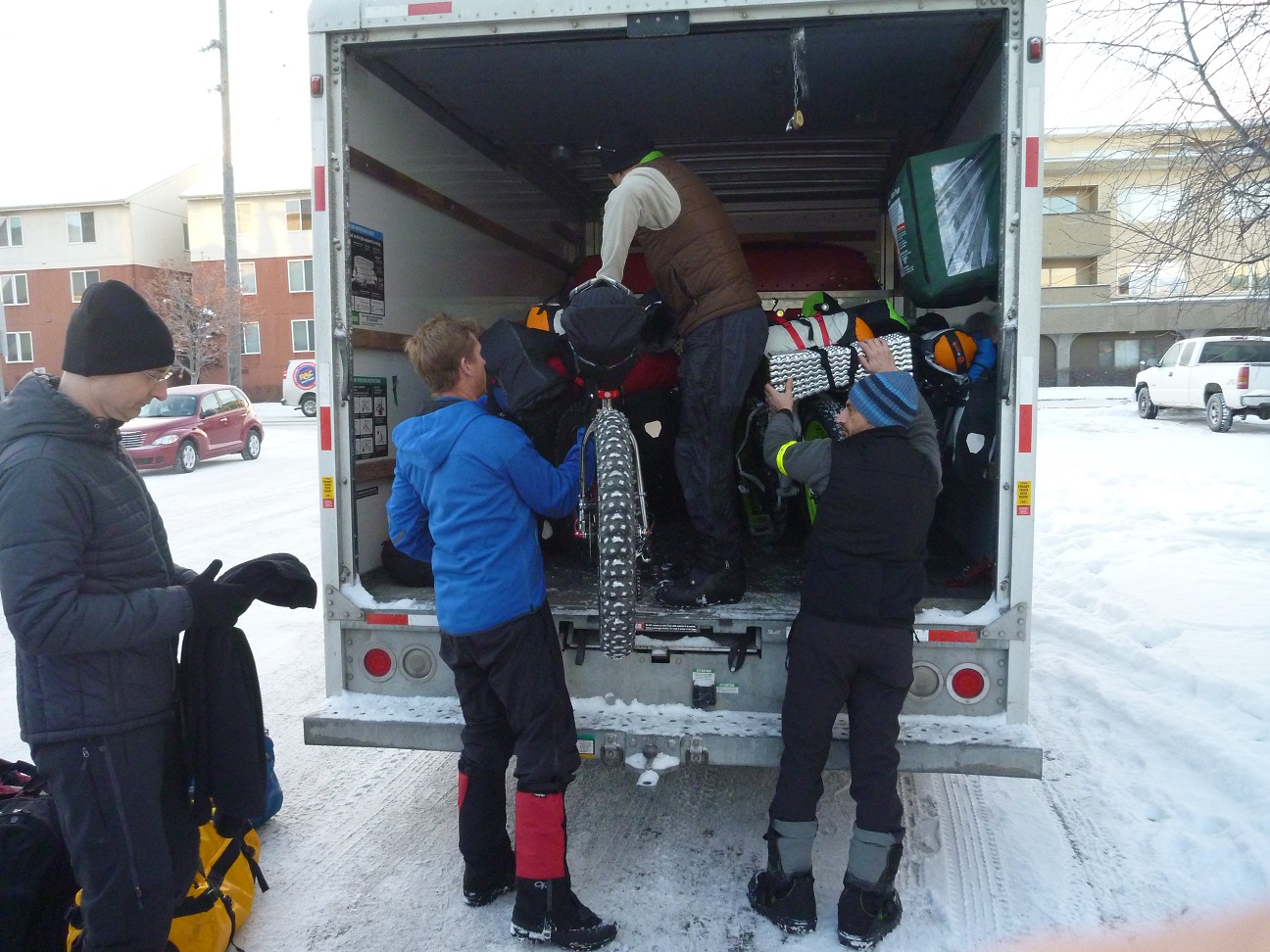
Time to get busy loading the truck with expedition-ready fatbikes, cache drop bags etc


Out amongst those mountains is where we were headed. A few hours in the van gave us all a chance for introductions and to share bike adventure stories.


We unload and begin our ride from the iconic Pt MacKenzie general store. The ITI race began here for many years, until fire damaged the store.


Bill did a quick ride briefing, we rechecked our packing and paused for a group photo. It was interesting to see and chat about the setups - some with racks and full panniers, others with lightweight Revelate seatbags and slings. We had little idea from this point on, all of our future expeditions would be gauged on this trip.


We were heading to the other side of the iconic 4,396ft peak called Mt Susitna, 'The Sleeping Lady' as it is also known, was the location of our base camp at Flathorn Lake. These snow roads form a major link to many small communities, via snowmachine and dogsled. It was hard to resist stopping every few kilometres to take snapshots, when you had a vista like this in front.


Our trail wound its way through stands of Spruce and Birch, in a Narnia-like winter wonderland.


...and over long straights of frozen marsh/swamp:


My mate Rob drew the short straw and had to carry the beer keg for the group.


Some of the local dogsled teams use this area often for race training, these teams can really hook along at speed and often travel quietly, courtesy is to let them through wherever possible.


To the North-East we had the company of the imposing spire of Mt McKinley, at 20,320ft it is the highest peak in North America.


We hadn't travelled very far along the trail and still had a ways to go. We often paused to soak it all in, take photos, adjust layers. The day rolled on, we settled into a rhythm, finding our own groove on the trail and enjoying the moment.


Bill and Kathi warned us about group mentality and about how it can affect each of us. We all run on different temps and clothing layers, calorie requirements, hydration and rest room breaks - so if you need to stop, you stop. Stopping to adjust your layers, tyre pressure, hydrate or feeding, might mean you'll run more efficiently over the long term, for your own circumstances. With a group mentality you may blindly dig yourself deeper into reserves, beyond which you may not recover quickly enough to replenish and then run depleted. This camp was as much adventure as it was teaching us to learn the very subtle nuances about our own physiology that we may never have experienced before.

 
I was so stoked to be out there.


We dropped down off the rollercoaster and onto the frozen stretch of Flathorn Lake. There were several patches of overflow, the lake ice was covered in only a few inches of loose snow, making it treacherous for us without tyre studs. Fell over a lot. Hubbard.

We got to base camp and Bill showed us our bivvy area. Straight to work stomping out our pad, melting snow for our bottles and setting up bedding.


Pure luxury and totally unexpected - I knew there was a hut at base camp, I pictured it as a small 1 room log cabin - bit of a shock to find a large, self supported cabin.


No K-rations here either. More carbonara? Or would you prefer another prawn cutlet...


I was beginning to feel like I'd missed a turn and got mixed up with some degustation group, but no, Bill and Kathi reassured us over the next week we would appreciate the cabin comforts, as the cold, the exposure and the training started to take effect on our minds and bodies.


 The night rolled on and the stories flowed, about blizzards, 40 below temps, racers postholing their way through feet of fresh snow and the raw, unforgiving landscape. We had bluebird weather today, temps ranged -2C to -15C, low humidity, barely a breath of wind and these conditions were considered by many as mild.  I could only imagine how bad it could get out there, and I'm told that's what breaks people and equipment. I was here to learn, trial equipment, dial in my layers, and to see how I would adapt to the conditions. Yesterday was easy, but I was eagerly looking forward to tomorrow.


Sunday, 2 June 2013

Anchored down in Anchorage

I had a few days in Anchorage to explore, get a few extra items and acclimatise before I left for Iditarod. The snow and ice was a novelty, the cold was strangely enjoyable.


Under the snow was the ice. Under the ice was the road. On top of the snow was the bike, on top of the bike was me. Sometimes, the bike was not on top of the snow, but on top of the ice. Then, with seemingly no provocation, I was on top of the ice - HARD. With my hands in the pogies, they were trapped and you'd go down with the ship - shoulder and hip first hubbard style. There was bound to be plenty of that in the coming weeks...


Followed the Chester Creek trail, a great mix of XC ski, walk and bike trail and the best alternative to mixing it with traffic on the road. First experience with overflow - the pressure of the ice forces the water up through cracks in the ice and snow, the water then flows and refreezes into a slick surface, or it can soften the surrounding ice to slush, making the surface very unpredictable. Overflow is not to be messed with, the ice might be a metre thick, or 3mm thick - and you might have still, icy water, fast flowing water, or a black void beneath. Riding over it without studded tyres is fun though.


The trail is very pretty, winding its way along the creek, through some tunnels, ending down at the Tony Knowles coastal trail. The lagoon is popular for ice skating and fatbike ice crits. I caught up with Billy Koitsch from Arctic Cycles, he has his bike hire stand here each weekend. Billy recently went for a longish ride though the frozen North, read a bit more on that adventure HERE.


Heading along the coastal trail straight into snow showers. The trail flow varies, largely due to the big 9.2 earthquake of '64 that dramatically changed the coastline, Alaska is still active in terms of 'quake activity.


The view NNW over Knik Arm. Normally you'd see the other side to Point MacKenzie, but today the snow showers set in with the wind blowing at 20Kn. Yes, they are ice floes out on the sea.


Anchorage sits at about 61 degrees N latitude, so during winter the sun never rises directly overhead, just travels in a low arc, colours of a sunset can last for hours when it pokes through the cloud - this pic was taken at about 2pm (despite what the camera metafile states, I didn't change the camera timezone).


End game today was the Kincaid recreation park - a dedicated multi-use snow park with groomed trails for XC skiers, snowshoers and fatbikers.


Home along the creek trail, the sky was ablaze with light. The Northern Lights activity was at medium, but with snow showers and cloud cover the visibility was zero.

 
I wanted to keep riding through the night, the atmospheric conditions were just perfect.

Sunday, 7 April 2013

Muru Witjira fatbike build for the Ultimate Adventure - Part 2

Ah, there's nothing like that feeling of 40+ hours travel time, aisle seats, double helping inflight meals, 4 airports, toting a 25kg backpack, towing a 23kg bikebag and the indignation of almost having to strip naked for each airport screening check. The TSA never repack your stuff the way you like/need it...

So, yes I arrive in Anchorage, Alaska, 99508. Catch a taxi from the airport, "Where are you going?" asked my Indian taxi driver, in his Americanised Punjab accent. "Cottonwood St, mate" I replied. "Yes very good, but which end?" he questioned. Before he had answered, I remembered the length of streets from previous US trips, and how they can sometimes span whole counties. My maps were in my pack. In the trunk of the taxi. It was 12F below. I remembered what the B&B looked like from the website picture...but it was a summer picture. No problem, "I remember what the house looks like" I enthusiastically added. We turned North off 36th and 2 minutes later I spotted the B&B:


Home for the next few days before camp was the Alaska European bed & breakfast. Awesome place to stay - homely feel, good neighbourhood, good riding closeby and public transport a short walk away for trips downtown. Most of the stuff I needed was only about a 40 min walk each way.

In part 1 of the Muru Witjira build I referred to the D.E.D. tours and the build parameters, but there are times when you gotta bend the rules. So when it came time to start wrenchin', would you choose to build the bike here at 10F below (8:30am):


Or in here at 18F:


Yeah, I thought so. Soft. Whatever, I don't need to justify myself. There's plenty of time ahead to harden up to the cold, but underneath that fluffy snow was a half inch of ice, making it slipperier than a butchers door knob. Moose were about too.

So here's what came outta the bikebag:
  •  Salsa Moto Ace bars - I like the 17 degree bend and it gives a lot of clearance for the levers to any harness or handlebar bag system
  • SRAM X0 2x10 gruppo with twisties - I like the higher shift cable tension to overcome contamination and the simple mechanism of twist shift 
  • BB7 brakes - I like the ease of adjustment and field servicibility of mechanical disc brakes
  • Selle Italia SLK saddle - my butt likes this seat
  • Ritchey Comp seatpost - I like the sturdy alloy post, especially for heavy seatbag usage
  • Crank Bros Mallet 3 - I like the ease of service, needle roller bearings, big platform, studs and open design for snow clearing
  • Extras - Blackburn Mammoth pump; bag of bolts, washers and spacers; Surly ultralight tubes
  • Lubricants - SRAM Johnnisnot cable grease, Motorex 2000 grease, Morgan Blue extra dry silicone chain lube, MTB Mechanic Bike Butter PTFE grease
     

...and here's what I had to build it with, a Topeak 19 and Leatherman Charge Al (brain, eyes, mouth and right hand also used during build):


About this point I discovered the TSA's repacking efforts had bent the rear rotor - mouth was used for swearing at this time of the build. No prob, I was heading downtown anyways to catch up with the team from Speedway Cycles to get a few things. Intermittent snow showers, icy conditions, still a novelty to this QLD'er - the view down Northern Lights Blvd:
 
 
Look to the ENE and you see the shrouded and snow-capped Chugach mountains.
 
 
 So much fat. Just like the fixie is to New York, fatbikes dominate as the main bicycle transport in Anchorage at this time of the year. Keen eyes will spot a picture on the wall of Adventuruss on his 10 desert solo expedition. 


I upgraded to a 180mm rotor and adaptor, picked up some boots and tyres I had on order, as well as some light pogies and a large Revelate pocket. The boots were my plan B, I had bought some Lake 302s and Berghaus supergaiters months prior to the trip, but just wasn't happy with them in a few ways, when compared to the 45NRTH Wulvhammers. Turned out to be a good choice.


The 180mm rotor was going on the front, first MacGuyver challenge of the day was to space over the front caliper adaptor 4.?mm on the Swale fork. This generation of Swale fork used a front offset IS mount (basically to suit a regular 100mm OLD front hub rotor offset), but the Hope Fatsno 135mm front hub uses a rear rotor offset, so the caliper was sitting too far outboard - you can see the caliper mounting bolt threads.

 
Hmmm, digging through my bolts and spares I found some M5 bidon cage spacers, perfect.

 
I'd like to say I bored out the hole to M6 using a corkscrew off the leatherman and a modified electric toothbrush MacGuyver style - but no, there was a battery drill and bit set in the garage. I had to hand-mill the thickness of the spacer down a fair bit, the leatherman had a file for that job. The tips of my fingers went numb for a week after holding the spacer against the file.


Cables were lubed up with Ride Mechanic Bike Butter. 


Next challenge was the front derailleur. Remember how the cranks were off my Moonlander? Well, the Surly MWOD Moony cranks are a full 10mm further outboard than regular fatty cranks, to clear a monster BFL on a Clown Shoe. My mistake was that I grabbed a spare direct mount front derailleur bracket from my spares, but it was to suit a Mukluk and regular fat cranks. The X0 front derailleur was stretching to shift into the big dog, so I drilled another hole in the bracket, shimmed it with 1 washer at the top and two on the bottom bolt to angle the cage out. Ghetto, but it worked, no other option as no Moonlander front derailleur brackets were in town.


Tidy up a few loose ends and the bike was ready to session. I chose non-studded tyres, the durometer of the Husker Dus is matched well to the snow conditions so traction wasn't too bad. First ride was in the snow and ice on the road - the plan had come together.
 
  
On another trip to the US a few years ago, I built another bike specifically to suit that trip. Trip was in California, hitting up as many mtb trails up the west coast, I built up a Santa Cruz Blur - and the first ride on that bike was on US soil at Montana De Oro, just a short drive from Santa Cruz. I really dig the symbolism of that and the adventures I have with my bikes are priceless.
 
This trip was many things - I have been waiting for several years for all of these events to be close enough together to attend them on the one trip: Iditarod Trail Invitational (ITI) training camp; DT Swiss Certification course at UBI in Oregon, Park Tool Tech Summit (my 4th) in Portland; a 10 day solo backcountry bikepacking trip through central Oregon; and to help justify it all - it was an age milestone birthday. I even slotted in a Monster Jam event while in Portland, but nowhere near as good as the last one I went to at Anaheim Stadium a few years back.


The tyres measured up at 102mm on the Darryls, you can see from the pics there is plenty of room to fit a BFL, Nate, Bud or Lou if that is your flavour. More details about the specs and measurements on the frame and fork are available at Muru Cycles.


Lay out all the bags and fittings for the camp, then time for a ride on local trails to settle in the mechanicals.


Pictured from top left and working clockwise: Revelate Viscacha (large volume rackless seatbag) with 2 Spockets (mesh pockets) attached; Revelate Harness (fit to handlebars to carry drybag and Z-Lite) with large Revelate Pocket and another Spocket; Dogwood Designs Pogies (you store your hands in them); Salsa Anything Cages with OR bottle cosies (for 1L Nalgene bottles); ghetto fabbed silver drybag to cover the MSR fuel bottle on the downtube; Revelate Gastank (for toptube near stem) Revelate Jerrycan (toptube next to seatpost); Revelate custom framebag (fits in frame front triangle)


The Muru Swale fork has lugs for mounting bidon cages, or these 3 bolt Salsa Anything cages. Great for tents, sleeping pads - light bulky items. The bottle cosies are Outdoor Research items (I don't rate them highly), holding 1L wide mouth Nalgene bottles.


Viscacha seatbag is cavernous (not holding a lot in this pic) with very well thought out strapping and support. MSR Whisperlite stove in neoprene bag, 5 days of rations, 2 nesting titanium pots, a spoon and a first aid kit all inside the bag, with a small silnylon tarp in a stuffsac strapped to the top.


Main custom framebag (originally made for my titanium Fargo) has binoculars, handtowel, toiletries and other important stuff in the top section pocket Lower pocket has spare tube, tools, spare bolts, zip ties - basically a mini shed. Jerrycan (toptube/seatpost) bag has camera batteries and SD cards, chemical handwarmers. Gastank (toptube/stem) has electricals - lights, brackets, bits of velcro, Power Monkey battery, headtorch, other stuff. Silver bag on downtube is covering the MSR fuel bottle, in a s/steel bidon cage.


Front on view of the large Pocket, for gloves, headgear, bulk snacks, other stuff. Behind this is the Harness that holds a large drybag for sleeping bags (2) outer layer clothes (Primaloft pants and jacket) VBL socks, down vest. Not pictured is the Z-Lite pad, this was in front of the harness and the straps for the pocket formed the mounting method for this. Basically it was for the lightweight, bulky items.


Cockpit. Pogies for hands, lollies, snacks, batteries for lights, chemical handwarmers. Osprey camera bag for matches, bulk Powerbars/Clif bars (must be defrosted inside jacket pocket for at least 4 hours before consumption). Exposure Diablo Mk4 light. Garmin 800.

 
Poor little 800, it took a beating. After a while it didn't want to play anymore.


There were still a few days until I set out on the Iditarod trail - time to explore a bit around town, fall over on the icy roads, test clothing and enjoy the surroundings. I'm falling in love with Alaska...